

AI is gaining ground in antibody discovery. Partnerships are multiplying, potential deal values are reaching into the billions, and a growing number of AI platforms are finding their way into biopharma R&D. What remains notably rare, however, is outright acquisitions.
The contrast is striking. AI models promise to reshape how antibodies are discovered and designed, but pharma still appears reluctant to buy into them fully.
So why the caution? To answer that, we looked at what AI can actually deliver today, what remains to be proven, and where its real economic value could lie—drawing on insights from our AI and Drug Discovery Leadership Study and our analysis of dealmaking data since 2022.
Read more about this report's methodology.
AI in antibody discovery: What actually works, and what doesn’t
To separate AI’s actual capabilities from its longer-term promise, we examined where the technology stands today, drawing on results from our AI and Drug Discovery Leadership Study. The clearest divide is between optimization, where AI is already delivering, and de novo design, where the potential is greater but the proof is still emerging.
Optimization: AI’s Most Mature Use Case
Antibody optimization starts with something tangible: a binder that already works. The challenge is to make it better by improving properties such as affinity, stability, specificity, immunogenicity or overall developability.
The fact that it has a starting point makes optimization particularly well suited to AI. The task is relatively well defined, many of the desired properties can be measured experimentally, and decades of antibody engineering provide data from which models can learn. Recent studies have shown that models can identify sequence changes that improve properties such as affinity, specificity and developability, including across several properties at once.
“With millions of antibody sequences available, AI can learn what tends to work and what doesn’t—and use those patterns to guide sequence optimization, from affinity maturation to developability.”
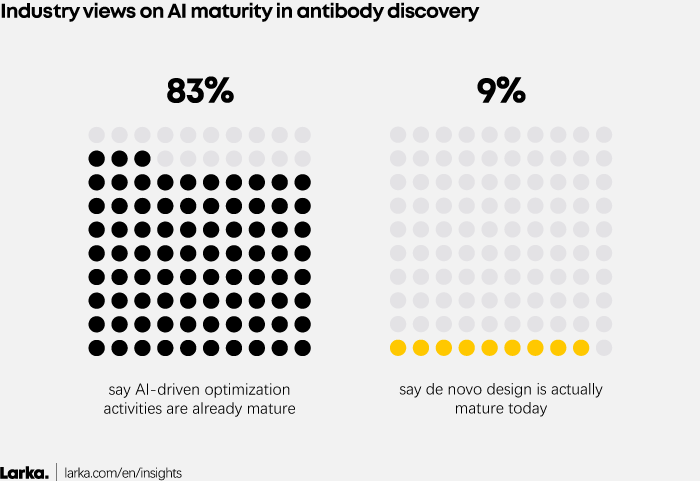
Instead of physically testing every possible variant, AI can help narrow the search. Models can predict which sequence changes are most promising, allowing researchers to focus experiments on a smaller and potentially stronger set of candidates. A maturity reflected in our industry panel, which highlighted a broad consensus that optimization is already delivering today (see Figure 1).
Source: Larka’s AI and Drug Discovery Leadership Study, H1 2026
Optimization, however, has a structural limit: it needs a starting antibody. AI can improve an existing binder, but it does not answer the more difficult question of where that binder comes from in the first place. That is the promise of de novo design: moving AI from improving the starting point to creating it.
De novo design: Bigger promise, less proof
Instead of improving an antibody that already exists, de novo design’s goal is to generate new antibodies computationally from target information. In principle, this could shift discovery from screening large libraries to designing targeted candidates.
But the task, however, is much harder than optimization. There is no proven antibody around which to search. Models must navigate an enormous sequence space and predict which designs will bind the target while also displaying the properties required of a developable drug.
Data adds another challenge. Unlike small molecules, antibody discovery has fewer large, standardized datasets linking sequences to experimental outcomes—particularly when it comes to failures. This is partly because many discovery methods are designed to find binders, not record non-binders. In techniques such as phage or yeast display, promising antibodies are progressively selected while unsuccessful ones are discarded, often without being individually measured. In animal-based approaches, selection can happen within the immune system itself, meaning researchers primarily recover the successful candidates. The result is plenty of information on what works, but far less on what does not—leaving AI models with fewer negative examples to learn from.
The field is progressing quickly, with recent studies demonstrating experimentally validated AI-designed antibodies. But generating a binder is not the same as generating a developable drug, and clinical validation remains limited.
“We know AI can generate new binders. The harder question is whether it can do so reliably, across targets, and consistently produce antibodies with the properties needed to become drugs.”
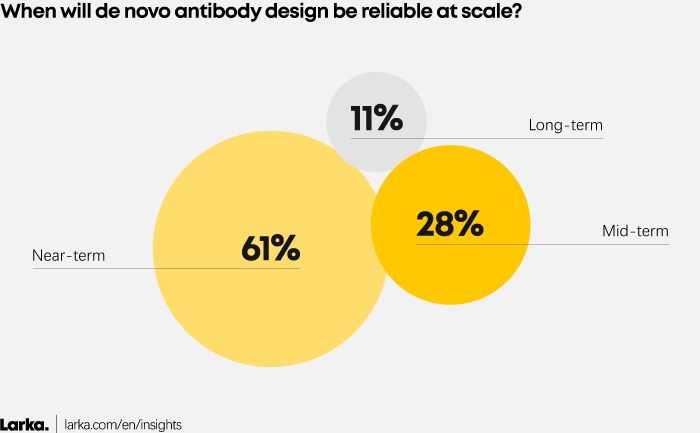
The debate is therefore increasingly about when, rather than whether, de novo will become reliable at scale. Optimization shows what AI can deliver today; de novo shows how much further it could go. The next question is what these upstream improvements could mean economically downstream.
Source: Larka’s AI and Drug Discovery Leadership Study, H1 2026
The downstream economics of upstream improvements
The value of AI in antibody discovery goes beyond making discovery faster or cheaper. Its bigger potential lies in improving which candidates enter the far more expensive stages that follow.
Much of the cost and risk in drug development comes later, particularly during clinical development. Better decisions upstream could therefore have disproportionate value. By identifying liabilities and weaker candidates earlier, AI could help programs fail faster and cheaper, while better-optimized candidates may enter development with stronger properties from the outset.
Optimization already provides part of this lever today. If de novo design matures, it could push the advantage further upstream by generating stronger starting candidates before optimization even begins. At scale, fewer downstream failures could improve R&D productivity and free capital for additional programs—particularly valuable as patent expirations increase pressure to replenish pipelines.
The potential is significant, but difficult to prove. Drug development takes years, meaning the downstream impact of better discovery decisions will take time to quantify. So how much confidence is pharma actually placing in that potential? While clinical proof will take time, pharma’s dealmaking already offers a window into how the industry is weighing the opportunity today.
What the deals are saying: Lots of interest, cautious commitment
Among the dealmaking activity of the world’s top 20 pharma companies, our analysis of 67 major AI drug discovery deals during the 2022-2026 period suggests a clear pattern: activity is accelerating and commitments are growing, although pharma continues to favour access and optionality over ownership.
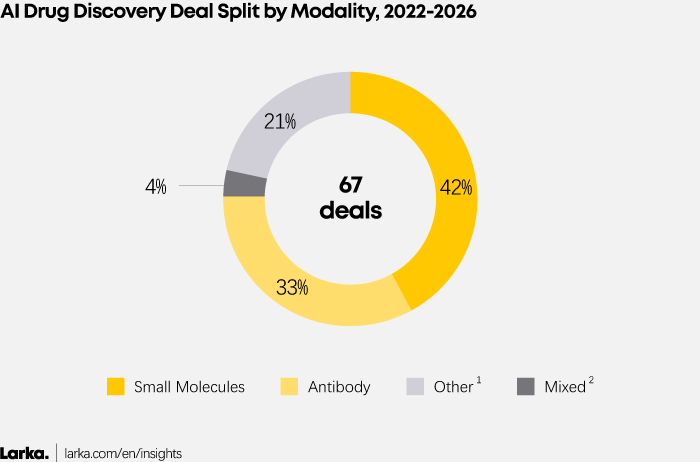
1. Other: deals not tied to a specific drug modality—e.g. compute infrastructure, agentic/workflow platforms
2. Mixed: deals explicitly naming both small molecule and antibody/biologics as modality focus
Source: Larka's AI & Data Lab
A clear preference for partnerships
Across AI drug discovery, deal activity has increased markedly in recent years, rising from only a handful of transactions disclosed in 2022 to more than 20 announced by 15 September 2026. Within this broader acceleration, antibody discovery has emerged as a consistently active area of AI dealmaking behind small molecules—which remain an easier bet for investors given their more mature data and track record (see Figure 3).
Outright acquisitions of AI drug discovery companies appear to remain clearly uncommon. Collaborations, licensing agreements and platform partnerships continue to be the preferred routes for accessing AI-enabled capabilities, including in antibody discovery, the focus of our analysis.
Big numbers, but limited risk
The headline value of some AI drug discovery deals can be striking, but much of that value remains conditional. Sanofi's 2026 Earendil agreement includes $160Mn upfront and near-term against up to $2.56Bn in milestones, while Roche's 2025 collaboration with Manifold Bio combines a $55Mn upfront payment with up to approximately $2Bn in potential milestones, and Nabla Bio's 2025 de novo antibody design collaboration with Takeda follows a similar pattern, with double-digit-million upfront payments against over $1Bn in potential milestones.
At the same time, several recent antibody-focused collaborations, including BMS–Chai Discovery and Pfizer–Chai Discovery, were announced without financial terms being disclosed. This makes headline deal values an imperfect measure of how much capital pharma is actually committing upfront.
Milestone-heavy structures are standard in pharma and are not specific to AI. Taken together, however, these deal structures are consistent with a relatively flexible approach: pharma can gain access to emerging AI capabilities today while increasing its financial commitment as technologies and programs demonstrate value.
Pharma is spreading its bets across platforms
Rather than selecting one technology winner, pharma is building relationships across competing approaches. Lilly stands out as one of the most active pharma players in our dataset, with collaborations spanning several AI-enabled discovery platforms, including multiple antibody and biologics-focused partnerships. Its activity in antibodies alone extends across different players and approaches, including XtalPi/Ailux and Profluent, reinforcing the broader pattern of accessing complementary AI capabilities rather than committing to a single platform.
This diversification is not unique to Lilly. For instance, AstraZeneca has partnered with both Absci in 2023 and Nabla Bio in 2024 on AI-enabled antibody discovery and design. Across antibody discovery, pharma companies are building relationships with multiple AI players, preserving the flexibility to test different approaches as the technology evolves.
Platforms are shared across competitors
The optionality works both ways. Within just over a year of launching its de novo antibody design platform, Chai Discovery has entered partnerships with Eli Lilly, Pfizer, Novartis, argenx and Bristol Myers Squibb—five competing pharmaceutical companies accessing the same underlying technology. Similar patterns can be seen elsewhere: Nabla Bio has partnered with AstraZeneca, BMS and Takeda, while XtalPi/Ailux works with Lilly, J&J and UCB.
This illustrates a defining feature of the model: partnerships provide access rather than ownership. Pharma companies can tap into AI-enabled antibody discovery capabilities without acquiring the underlying platform, while technology providers retain the ability to develop and deploy their platforms across multiple customers.
Successful relationships are being scaled
Partnerships do not necessarily remain small. The dataset shows a recurring test, validate, then expand pattern across AI drug discovery, including in antibodies.
Sanofi–Earendil moved from a potential $1.72Bn antibody deal in 2025 to another worth up to $2.56Bn in 2026. Takeda also returned to Nabla Bio in 2025 for a second antibody collaboration, following their initial partnership, with more than $1Bn in potential success payments. The same pattern extends beyond antibodies: in small molecules, Novo Nordisk expanded its 2023 Valo relationship in 2025, increasing its potential value from $2.7Bn to $4.6Bn.
Across modalities, the signal is similar: pharma is willing to deepen its commitment—but often after gaining experience with the platform first.
The analysis of dealmaking shows a clear pattern: high strategic interest, but controlled exposure. Pharma is increasing activity, diversifying across platforms and scaling relationships where confidence grows, while preserving flexibility over which technologies and partners ultimately win. That caution does not necessarily signal a lack of conviction. It may simply be the most rational way to invest in a technology that already shows value, while its long-term winners remain uncertain.
The rational bet: Why pharma partners rather than buys
AI’s ultimate value in antibody discovery remains difficult to quantify—particularly where it matters most: developing better drugs and improving clinical success. But pharma is not waiting for definitive proof before positioning itself.
The strategy reflects the technology’s different levels of maturity. Optimization already offers tangible value today, while de novo design represents the larger, longer-term opportunity. Partnerships allow pharma to pursue both: capture what already works, while gaining exposure to what could come next.
The economics could be significant. If better candidates translate into fewer downstream failures, even incremental improvements at the discovery stage could create meaningful value across large R&D portfolios. That could help protect margins or free capital for additional programs—particularly as patent expirations increase pressure to replenish pipelines.
But until that value can be demonstrated at scale, partnerships offer a rational middle ground. They provide exposure to the upside without requiring pharma to pay for full ownership before the technology, its ROI and the long-term winners are clear. In short, pharma can participate without having to pick the winner too early.
The question is therefore shifting from whether AI has a role in antibody discovery to how large that role will become—and when its impact will be measurable. That timing gap is fundamental: AI can evolve in months, while proving that a better-designed antibody becomes a better drug can take years.
